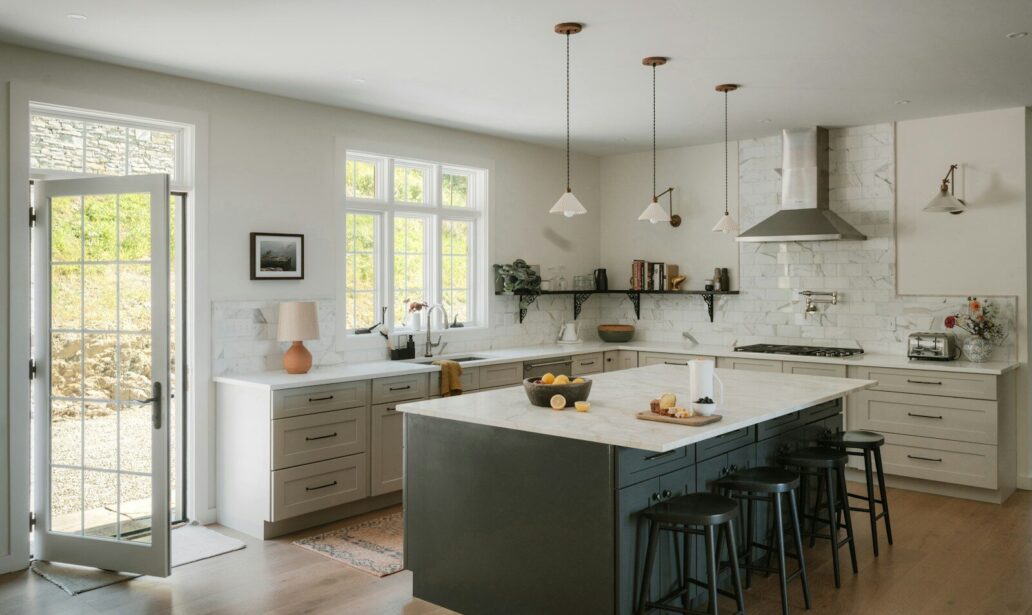
The kitchen island has become almost obligatory in contemporary kitchens. But simply adding a large rectangular island to the centre of a room does not necessarily make the space work better.
The more interesting question is what the island actually needs to do.
For some homes, it is primarily a preparation surface. For others, it becomes a breakfast bar, dining table, storage unit, social hub or even an informal home-working station. Trying to make it perform every function can result in an oversized piece that dominates the room.
Proportion is therefore critical.
An island needs enough clearance around it for people to move comfortably, open cupboards and use appliances without constantly getting in each other’s way. A smaller island with generous circulation space can often be more practical than a huge one that leaves narrow walkways.
There is also no rule saying a kitchen island has to be rectangular.
A curved end can soften a large kitchen, while a narrow peninsula can provide many of the benefits of an island where the room is more restricted. Split-level islands can separate preparation and seating areas, while a lower section can create a more conventional dining position.
Material choice can also help define the island as something more than another run of cabinetry. Timber, stone, painted joinery or a contrasting worktop can give it a distinct identity.
One increasingly useful approach is to think about the island as furniture rather than simply another kitchen unit. Legs, overhangs, open shelving and freestanding-looking sections can make the piece feel lighter and more integrated into the room.
There is also the question of whether seating is genuinely necessary. If a household already has a dining table nearby, adding four stools to the island may simply encourage the island to become an informal dumping ground.
A well-designed kitchen island should earn the space it occupies. Sometimes that means a substantial central workstation. Sometimes it means a compact piece with two stools. And in some kitchens, the most successful solution may be not to have one at all.
Photo by Clay Banks.